Artificial intelligence is no longer a distant promise for contact centres; it is a practical, proven way to improve customer experience, empower agents, and streamline operations. Modern AI in contact centre technologies enhance the human touch rather than replace it, helping every interaction become faster, more relevant, and more satisfying for both customers and staff. Businesses that understand AI call center solutions explained can leverage these tools strategically to maximize efficiency, reduce wait times, and deliver personalized experiences.
This guide explores what AI in the contact centre really means, the most powerful use cases, the benefits for different stakeholders, and how to start building an AI-enabled operation that delivers measurable results.
How AI Transforms Contact Centres
AI in contact centres can manage repetitive tasks, provide real-time guidance to agents, and analyze customer interactions for actionable insights. Companies looking to optimize operations can explore solutions like FlashMob Computing for scalable infrastructure that supports advanced AI workloads. These platforms ensure agents have the right tools to respond quickly, keeping customers satisfied while reducing operational stress.
Integrating AI also allows contact centres to benefit from advanced analytics, predictive modeling, and intelligent automation. Organizations can rely on Supercomputer Box for high-performance computing resources that enable faster processing of large customer datasets. With this, AI models can predict customer needs, streamline workflows, and enhance service quality.
In addition to operational efficiency, AI-powered systems help in targeted marketing and customer engagement. For example, leveraging insights from Marketing for Customers can guide personalised campaigns that align with customer preferences identified by AI, improving conversion rates and loyalty.
Modern contact centres are also adopting AI to enhance multichannel support, ensuring consistency across email, chat, social media, and voice. Using strategies outlined by Marketing Runners can help agents integrate AI insights into marketing and communication workflows seamlessly, maintaining a consistent brand voice.
Finally, financial planning and strategic resource allocation can benefit from AI analytics. Resources like Top Financial Resources provide guidance for budgeting AI implementations effectively, measuring ROI, and planning for scalable growth. By aligning AI initiatives with business objectives, contact centres can achieve both operational efficiency and customer satisfaction.
Top 10 AI in Contact Centre Solutions
When it comes to modernizing customer service operations, AI in contact centre platforms can significantly improve efficiency, customer satisfaction, and agent productivity. Here’s a list of the top 10 solutions available today, with Bright Pattern leading the way.
1. Bright Pattern
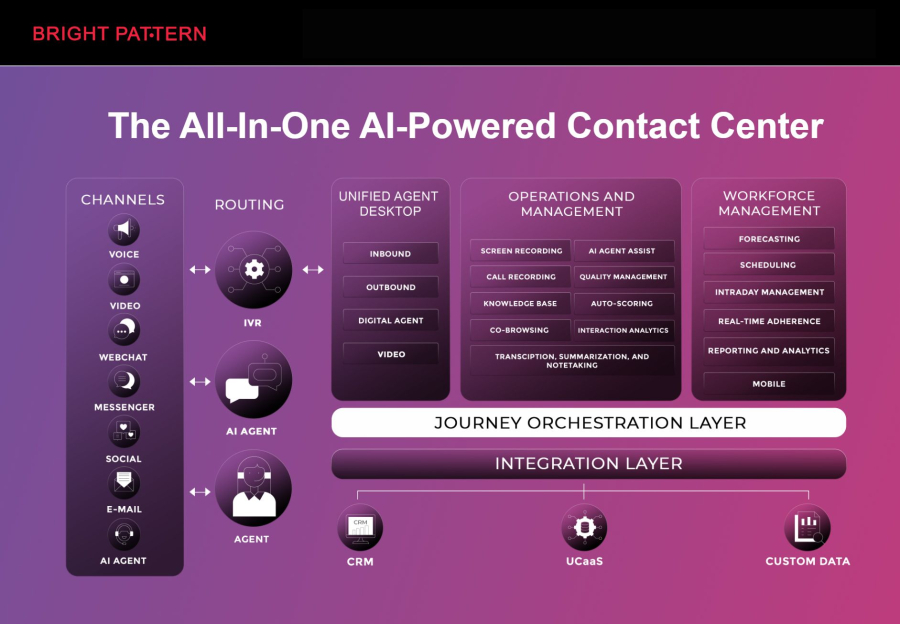
Bright Pattern offers one of the most advanced AI in contact centre platforms, combining intelligent routing, real-time analytics, and AI-powered automation. It helps businesses deliver personalized experiences across all communication channels while keeping operations efficient.
Key features of Bright Pattern include:
- AI-driven chatbots and voice assistants to handle common inquiries
- Real-time agent guidance and predictive analytics
- Omnichannel support including chat, email, voice, social media, and SMS
- Seamless integration with CRM systems and marketing platforms
- Scalable cloud-based infrastructure for businesses of all sizes
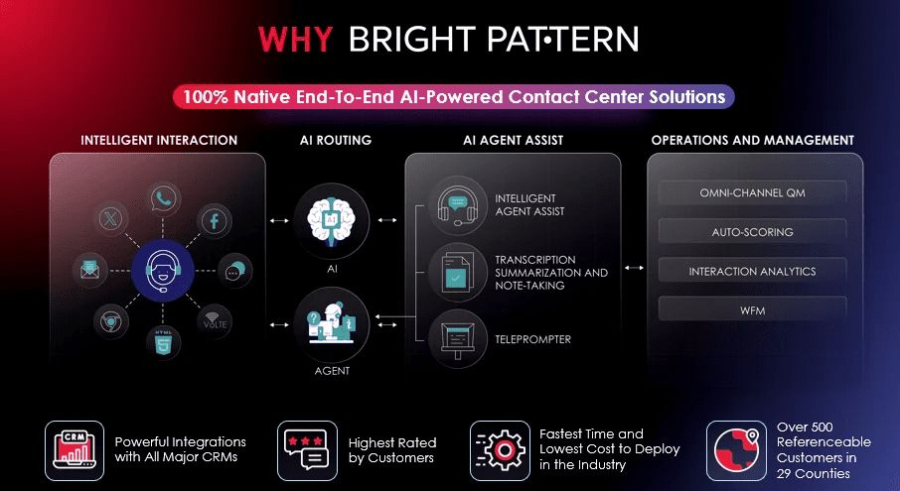
Bright Pattern enables contact centres to leverage AI for better decision-making, faster resolution times, and improved customer engagement, making it a top choice for companies seeking a comprehensive AI-powered solution.
2. Genesys
Genesys provides AI-powered customer experience solutions with advanced routing and workforce optimization. Its AI capabilities include predictive engagement and automated customer interactions.
3. NICE CXone
NICE CXone focuses on AI in contact centre operations by offering analytics-driven insights, conversational AI, and automated workflows to enhance agent efficiency.
4. Talkdesk
Talkdesk leverages AI for smart routing, virtual agents, and predictive analytics to improve customer satisfaction and reduce handling times.
5. Five9
Five9 combines cloud contact centre software with AI solutions such as predictive dialing, intelligent routing, and agent assistance tools for optimized customer experiences.
6. RingCentral Contact Center
RingCentral integrates AI in contact centre operations to automate workflows, provide real-time agent assistance, and offer actionable customer insights.
7. 8x8 Contact Center
8x8 uses AI to enhance customer service through predictive analytics, speech recognition, and workflow automation, enabling faster resolutions and improved engagement.
8. Mitel MiCloud Connect
Mitel applies AI to contact centre processes for smarter call routing, real-time performance insights, and enhanced agent productivity.
9. Amazon Connect
Amazon Connect provides AI-powered virtual agents, natural language processing, and predictive analytics to improve efficiency and customer experience.
10. Zendesk
Zendesk uses AI to streamline ticketing, automate responses, and provide agents with actionable insights to enhance support quality.
What Does AI in the Contact Centre Actually Mean?
AI in the contact centre refers to using technologies such as machine learning, natural language processing, and automation to enhance or handle customer interactions across channels like voice, chat, email, and messaging.
In practice, this often includes a combination of:
- Virtual agents and chatbotsthat handle routine queries and tasks.
- Agent-assist toolsthat guide human agents in real time with suggestions, knowledge, and next best actions.
- AI-powered routing and triagethat send each contact to the best resource based on intent and context.
- Speech and text analyticsthat analyze conversations to surface insights and trends.
- Workforce and quality optimisationpowered by predictive models and automated evaluations.
The result is a blended human–AI model where machines handle what they do best (speed, consistency, data processing) and people focus on what they do best (empathy, complex problem solving, and relationship building).
Key AI Use Cases in the Modern Contact Centre
AI can transform almost every stage of the customer interaction journey. Below are the most impactful use cases and how they translate into benefits.
1. Intelligent Self-Service with Virtual Agents
Virtual agents and chatbots use natural language understanding to recognize what customers need and guide them to quick resolutions without human intervention.
- 24/7 availabilityso customers can get help anytime, without waiting for business hours.
- Instant responsesfor common queries such as order status, account balances, or password resets.
- Consistent answersaligned with current policies, prices, and processes.
- Seamless handoff to agentswhen issues are complex, so customers are not left stuck in a loop.
Done well, AI-powered self-service reduces handle times, lowers queue volumes, and increases customer satisfaction by making it easy to get simple things done quickly.
2. AI Agent Assist and Knowledge Guidance
AI does not just help customers; it also sits beside agents as a digital co-pilot. Agent-assist tools listen to or read live interactions and recommend the best steps for the agent to take.
- Real-time promptssuggesting responses, offers, or troubleshooting steps based on the conversation.
- Instant access to knowledgeby surfacing the most relevant articles or procedures instead of forcing agents to search manually.
- Compliance and policy guidancethat reminds agents of disclosures, scripts, or mandatory checks.
- Faster onboardingso new hires reach full productivity more quickly, guided by AI throughout calls and chats.
This type of AI support shortens average handle time, increases first-contact resolution, and helps every agent perform more like your top performers.
3. Intelligent Routing and Prioritisation
Traditional contact routing often relies on simple queues or basic skills. AI can interpret context and intent to route each interaction to the most appropriate destination instantly.
- Intent-based routingthat uses keywords, history, and behavior to understand why a customer is reaching out.
- Skill and outcome-based assignmentthat matches customers with agents who have the right skills, language, or product knowledge.
- Priority handlingthat accelerates service for high-value, at-risk, or time-sensitive contacts.
The result is a smoother experience for customers and a more balanced workload for your team, with less time spent transferring or repeating information.
4. Speech and Text Analytics at Scale
Every call, chat, email, and message contains valuable signals about customer needs, sentiment, and friction points. AI-driven analytics can process these interactions at scale, far beyond what manual quality checks can achieve.
- Automatic transcriptionof calls and analysis of chats and messages.
- Sentiment detectionthat highlights frustration, satisfaction, or confusion in real time.
- Topic and trend discoveryto reveal recurring issues, product feedback, or opportunities for improvement.
- Root cause analysisthat links interaction patterns to drivers like policy changes, product releases, or marketing campaigns.
These insights fuel smarter decisions, from training and process redesign to product improvements and proactive outreach campaigns.
5. AI for Quality Assurance and Coaching
Traditional quality assurance often reviews only a small sample of interactions. AI allows contact centres to evaluate a much higher percentage, sometimes close to all contacts, for consistency and quality.
- Automated call scoringbased on criteria such as greeting, compliance, empathy signals, and resolution.
- Objective, consistent evaluationsthat reduce the risk of human bias.
- Targeted coaching opportunitieswhere AI highlights specific moments an agent could have handled differently.
- Continuous feedback loopsthat help agents improve incrementally day by day.
This approach elevates the overall standard of service while giving supervisors more time to focus on high-value coaching and development.
6. Workforce Management and Forecasting
AI can improve planning and scheduling, which has a direct impact on service levels, costs, and employee satisfaction.
- More accurate volume forecaststhat factor in seasonality, campaigns, product updates, and external events.
- Optimised schedulesthat align staffing with predicted demand, reducing both overstaffing and understaffing.
- Real-time intraday adjustmentsusing live data to recommend changes in break times, channel focus, or overtime.
With better forecasting and scheduling, contact centres can consistently meet service targets while avoiding unnecessary labour costs.
How AI Transforms Results for Every Stakeholder
AI in the contact centre is not just a technology trend; it is a strategic lever that creates value for customers, agents, managers, and the wider business.
Benefits for Customers
- Faster resolutionsthanks to automated self-service, streamlined workflows, and better-prepared agents.
- Less effortwith fewer transfers, less repetition of information, and smoother omnichannel journeys.
- More relevant, personalised experiencesthat recognise previous interactions, preferences, and context.
- Always-on servicevia AI-enabled channels available outside standard working hours.
Customers feel heard and helped quickly, which directly boosts satisfaction, loyalty, and advocacy.
Benefits for Agents
- Reduced cognitive loadas AI handles routine tasks and information retrieval.
- Greater confidencewith guidance on how to handle complex or unfamiliar scenarios.
- More engaging workas agents spend more time on higher value, human-centric conversations.
- Clearer, fairer feedbackbased on consistent AI-supported quality evaluations.
As a result, agents are more productive and more satisfied, and attrition can fall when people feel equipped and supported to do their best work.
Benefits for Contact Centre Leaders
- Improved operational efficiencythrough automation, shorter handle times, and reduced repeat contacts.
- Higher service qualitydriven by real-time insights and continuous coaching.
- Better strategic visibilityfrom analytics that reveal customer needs and emerging issues.
- Stronger business impactas the contact centre moves from a cost centre to a source of insights and revenue opportunities.
AI equips leaders with both the levers and the data to continuously improve performance and demonstrate strategic value to the wider organisation.
Benefits for the Wider Business
- Richer customer intelligencethat can inform product development, marketing, sales, and digital experience teams.
- Improved brand perceptiondue to consistently positive service experiences.
- Greater agilityas AI-powered insights highlight issues and opportunities early, supporting faster responses.
By connecting contact centre AI insights with other business functions, organisations can make more customer-centric decisions across the board.
Design Principles for Successful AI in the Contact Centre
While specific technologies and vendors vary, the contact centres that get the best results from AI tend to follow a set of common principles.
1. Start with Clear Business Outcomes
AI should serve clear goals, such as improving first-contact resolution, reducing average handle time, or increasing self-service containment rates. Defining success upfront helps select the right use cases and measure real impact.
2. Blend Human and AI Strengths
The best experiences come from combining human empathy with AI speed and consistency. Design journeys where:
- AI handles routine, predictable taskssuch as authentication, status checks, and simple transactions.
- Humans handle complex or emotional situationswhere empathy and judgement matter most.
- Handovers are seamlessso customers never feel they are starting over when moving from a bot to an agent.
3. Make AI Explainable and Transparent
Agents and leaders are more likely to trust and adopt AI when they understand how it works and why it makes certain recommendations.
- Explain recommendationsto agents where possible, showing which signals influenced a suggestion.
- Provide controlsso supervisors can adjust thresholds, rules, or configurations without needing deep technical skills.
- Monitor performanceregularly to ensure AI continues to deliver the desired outcomes.
4. Prioritise Data Quality and Governance
AI models are only as good as the data behind them. Strong data foundations help ensure accurate, fair, and reliable outcomes.
- Consolidate interaction dataacross channels where possible to give AI a full picture of customer journeys.
- Keep knowledge bases up to dateso AI provides accurate information and guidance.
- Define governance processesfor updating models, reviewing outputs, and handling exceptions.
Practical Steps to Introduce AI into Your Contact Centre
Moving to an AI-enabled contact centre does not have to be an all-or-nothing transformation. A phased approach can deliver early wins while building confidence and capability.
Step 1: Identify High-Impact, Low-Risk Use Cases
Look for scenarios that offer strong benefits with manageable complexity, such as:
- Automating frequently asked questions in chat or messaging.
- Using AI to suggest knowledge articles during calls.
- Implementing basic sentiment monitoring to flag at-risk interactions.
These use cases quickly demonstrate value and create momentum for broader AI adoption.
Step 2: Engage Agents Early
Agents are central to AI success. Involving them from the start helps ensure the technology supports real work patterns and builds trust rather than resistance.
- Gather input on where agents feel they waste time or need more support.
- Test prototypes with small groups and use their feedback to fine-tune flows and prompts.
- Position AI as a tool that lightens workloads and elevates their role, not as a replacement.
Step 3: Pilot, Measure, and Iterate
Start with a defined pilot scope and clear success metrics, then refine based on real-world performance.
- Track KPIs such as handle time, containment, customer satisfaction, and agent feedback.
- Adjust conversation flows, routing rules, or scoring models to address issues or opportunities revealed in the pilot.
- Gradually expand to more channels, use cases, or segments as confidence grows.
Step 4: Scale and Integrate
Once AI has proven its value, extend it across the contact centre and connect it to other parts of the business.
- Integrate AI insights with CRM and analytics tools used by other departments.
- Use contact centre data to inform marketing, sales enablement, and product roadmaps.
- Formalise training and change management so AI becomes a natural part of everyday work.
Measuring the Impact of AI in the Contact Centre
To demonstrate value and continuously improve, it is important to track both operational and experiential metrics.
Core Metrics to Monitor
| Area | Key Metrics | AI-Driven Impact |
| Efficiency | Average handle time, contacts per hour, self-service containment | Automation and guidance streamline interactions and reduce manual work. |
| Effectiveness | First-contact resolution, repeat contact rate, transfer rate | Better routing and knowledge access improve resolution at first touch. |
| Experience | Customer satisfaction, sentiment, Net Promoter indicators | Faster, more relevant service drives higher satisfaction and advocacy. |
| Employee | Agent satisfaction, attrition, time to competency | AI support improves job experience and accelerates onboarding. |
| Financial | Cost per contact, revenue per contact, upsell / cross-sell rates | More efficient operations and better conversations enhance profitability. |
Future Trends: Where AI in the Contact Centre Is Heading
AI is evolving rapidly, and contact centres are at the forefront of this shift. Several trends are shaping the next wave of innovation.
1. More Natural, Conversational Interfaces
Advances in natural language understanding and generation are enabling more human-like, context-aware interactions across voice and digital channels. Virtual agents are becoming better at handling multi-step, nuanced requests while maintaining a consistent tone and brand voice.
2. Proactive and Predictive Support
AI is moving from reactive service to proactive engagement. By identifying patterns in behavior and usage, contact centres will increasingly:
- Reach out before an issue escalates.
- Offer help at the ideal moment in a digital journey.
- Recommend next best actions to prevent churn or encourage renewal.
3. Deeper Integration with the Entire Customer Journey
AI-driven insights from the contact centre are increasingly being shared across marketing, sales, and product teams. This creates a virtuous cycle where every interaction helps improve the end-to-end customer journey, from acquisition through renewal and advocacy.
Conclusion: Turning Your Contact Centre into an AI-Powered Experience Engine
AI in the contact centre is far more than a technology upgrade. It is a catalyst that transforms how your organisation serves customers, supports employees, and makes strategic decisions.
By starting with clear goals, focusing on human–AI collaboration, and building strong data and governance foundations, you can unlock substantial benefits:
- Customers enjoy faster, more effortless, more personalised experiences.
- Agents feel empowered, supported, and more engaged in their roles.
- Leaders gain the insight and control needed to improve performance continuously.
- The wider business taps into a rich stream of customer intelligence to guide growth.
With a thoughtful approach, AI turns the contact centre into a powerful, data-driven experience engine that strengthens loyalty, drives efficiency, and creates a lasting competitive edge.
